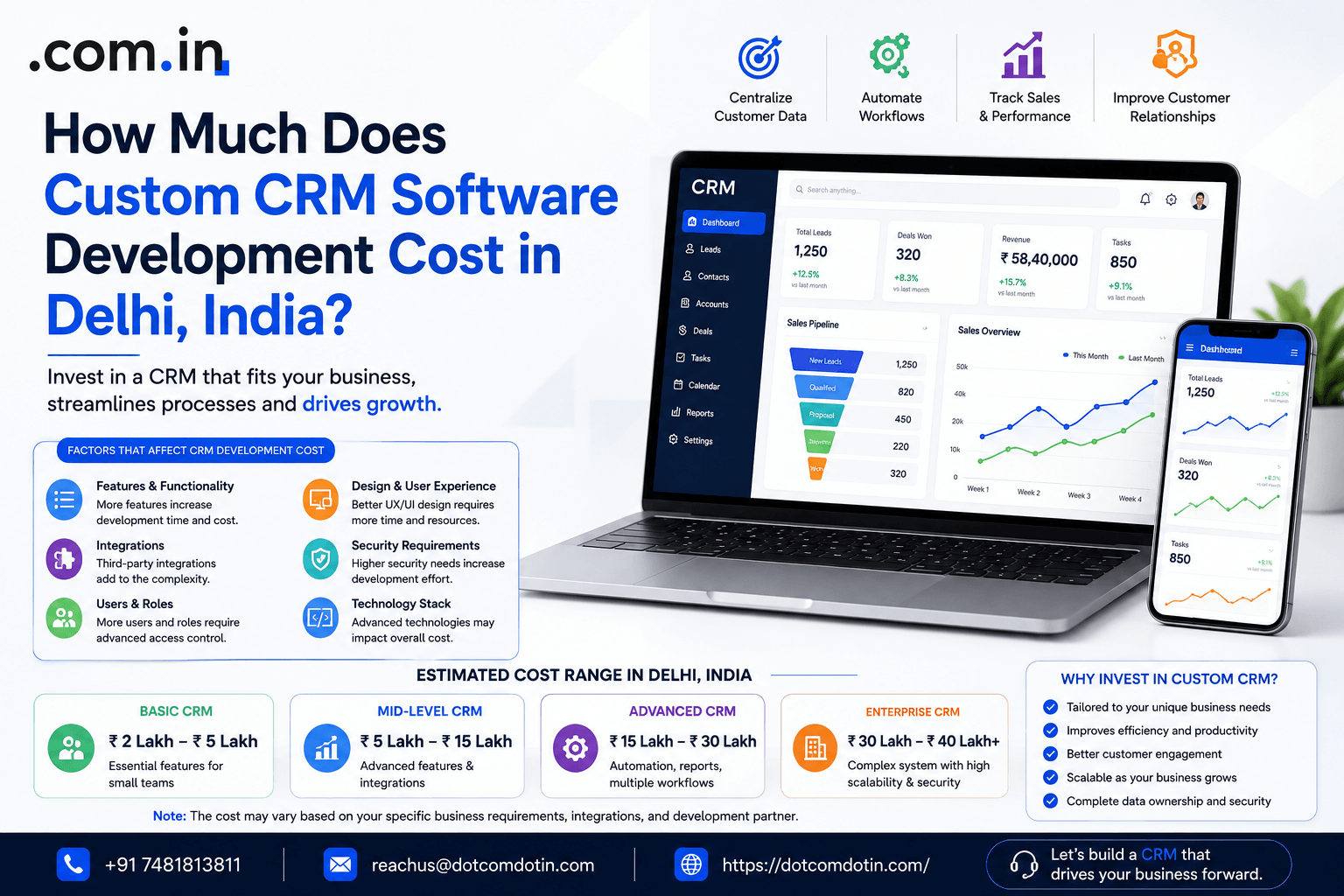
The cost of custom CRM software development in Delhi, India can vary significantly depending on the features, complexity, integrations, technology stack, security requirements, design, and development team involved. A simple CRM for managing leads and customer information may require a considerably smaller investment than an enterprise CRM with automation, analytics, mobile applications, third-party integrations, and advanced reporting.
For businesses considering a Custom CRM Software Development Company in Delhi, India, understanding the factors behind development costs is more useful than focusing on a single fixed price.
A practical estimated range for custom CRM development in India can start from around ₹2 lakh to ₹5 lakh for a basic CRM, ₹5 lakh to ₹15 lakh for a mid-level CRM, and ₹15 lakh to ₹40 lakh or more for a complex enterprise CRM. These figures are indicative rather than fixed quotations because every CRM project has different technical and business requirements.
The right CRM investment should ultimately be based on the business problems the software needs to solve, the number of users, required integrations, automation, scalability, and expected long-term value.
What Is Custom CRM Software?
Custom CRM software is a customer relationship management system developed specifically around the processes and requirements of a particular business.
Unlike an off-the-shelf CRM, a custom CRM can be designed around an organization’s existing sales, marketing, customer support, operations, reporting, and workflow requirements.
A custom CRM may include:
- Lead management
- Customer profiles
- Sales pipeline management
- Contact management
- Task management
- Follow-up reminders
- Email integration
- WhatsApp or communication integrations
- Sales dashboards
- Reports and analytics
- Employee management
- Role-based access
- Workflow automation
- Invoice or payment integrations
- Document management
- API integrations
- Mobile applications
The more complex these requirements become, the greater the development effort and overall project cost.
How Much Does Custom CRM Software Development Cost in Delhi?
Although the final price depends on project specifications, businesses can use the following broad estimate as a starting point:
| CRM Type | Approximate Development Cost | Typical Requirements |
|---|---|---|
| Basic CRM | ₹2 lakh–₹5 lakh | Leads, contacts, users, tasks, basic dashboard |
| Mid-Level CRM | ₹5 lakh–₹15 lakh | Automation, reports, integrations, advanced workflows |
| Advanced CRM | ₹15 lakh–₹30 lakh | Complex workflows, APIs, analytics, multiple roles |
| Enterprise CRM | ₹30 lakh–₹40 lakh+ | Large-scale operations, advanced security, extensive integrations |
These are indicative ranges, not standard market prices. A detailed project scope is required before a development company can provide an accurate estimate.
What Factors Affect Custom CRM Development Cost?
Several factors can influence the cost of developing CRM software in Delhi.
1. Number and Complexity of Features
Features are one of the biggest cost drivers.
A basic CRM containing customer records, leads, tasks, and a dashboard is relatively straightforward.
A more sophisticated system may require:
- Automated lead assignment
- Multi-stage sales pipelines
- Custom workflows
- Advanced reporting
- Customer portals
- Automated notifications
- Approval systems
- Role-based dashboards
- Document management
- AI-powered features
Every additional feature requires design, development, testing, and maintenance.
2. UI/UX Design Requirements
The user interface has a direct impact on development effort.
A straightforward administrative dashboard may require less design work than a highly customized CRM designed for hundreds or thousands of employees.
A professional CRM should prioritize:
- Simple navigation
- Clear dashboards
- Fast access to customer information
- Responsive design
- Consistent interface elements
- Mobile usability
- Role-specific screens
Investing in UX can be particularly valuable because CRM software is often used daily by sales, marketing, support, and management teams.
3. Number of Users and Roles
A CRM designed for five employees may have significantly different requirements from one designed for 500 users.
Multiple user types may require different permissions and dashboards.
For example:
Administrator → complete system access
Sales Manager → team performance and pipeline access
Sales Executive → assigned leads and customer information
Support Team → tickets and customer communication
Creating these permissions and workflows adds development complexity.
4. Third-Party Integrations
CRM software frequently needs to communicate with other business applications.
Possible integrations include:
- Email platforms
- Payment gateways
- Accounting software
- ERP systems
- Marketing automation platforms
- Telephony systems
- SMS gateways
- Google services
- Business intelligence tools
- E-commerce platforms
Each integration requires API research, development, testing, authentication, error handling, and ongoing maintenance.
Consequently, a CRM with multiple integrations can cost considerably more than a standalone system.
5. Automation Requirements
Automation can make a CRM much more powerful.
For example, when a new lead enters the system, the CRM could automatically:
- Assign the lead to a salesperson.
- Send a notification.
- Create a follow-up task.
- Send an email or message.
- Update the lead status.
- Notify a manager if the lead remains unattended.
These workflows can improve operational efficiency but require additional development and testing.
6. Reporting and Analytics
Basic CRM dashboards may show simple numbers such as leads, customers, and sales.
Advanced CRM platforms may require:
- Sales forecasting
- Conversion reports
- Employee performance reports
- Revenue analysis
- Lead-source analysis
- Customer retention reports
- Custom dashboards
- Real-time data visualization
Complex reporting requirements can increase both development time and database complexity.
7. Mobile App Development
If employees need to access the CRM from smartphones, businesses may require a responsive web application or dedicated Android and iOS applications.
A mobile application can provide features such as:
- Lead updates
- Customer calling
- Notifications
- Task management
- Location-based features
- Sales activity tracking
- Real-time CRM synchronization
Developing separate mobile applications generally increases the project budget.
8. Security and Data Protection
CRM software stores valuable business information, including customer details, sales records, employee information, communication history, and potentially financial data.
Security should therefore be considered from the beginning.
Depending on the project, security requirements may include:
- Secure authentication
- Role-based access control
- Encryption
- Secure APIs
- Activity logs
- Backup systems
- Session management
- Data recovery
- Access monitoring
Higher security requirements can increase development and infrastructure costs, but they are often essential for business-critical applications.
9. Technology Stack
The programming languages, frameworks, databases, hosting environment, and architecture can also affect the cost.
A CRM may be developed using technologies such as:
- PHP
- Laravel
- Node.js
- React
- Angular
- Vue
- Python
- .NET
- MySQL
- PostgreSQL
- MongoDB
The appropriate technology should be selected according to the CRM’s requirements rather than simply choosing the newest technology.
10. Development Team Location and Experience
Delhi has a large technology and software development ecosystem, so businesses can find teams with different pricing structures and levels of expertise.
Development costs may vary based on whether you work with:
- Freelancers
- Small development teams
- Specialized software companies
- Full-service development agencies
- Enterprise technology partners
An experienced development company may charge more initially but can potentially reduce risks related to architecture, security, scalability, testing, and long-term maintenance.
What Is the Typical CRM Development Process?
A professional CRM development project generally follows several stages.
Step 1: Requirement Analysis
The development team identifies business processes, users, features, integrations, and technical requirements.
Step 2: Project Planning
The scope, technology, timeline, milestones, and development approach are defined.
Step 3: UI/UX Design
Wireframes and interface designs are created before development begins.
Step 4: Software Development
Developers build the CRM’s frontend, backend, database, APIs, workflows, and integrations.
Step 5: Testing
The software is tested for functionality, security, usability, performance, and compatibility.
Step 6: Deployment
The CRM is deployed to the selected hosting or cloud environment.
Step 7: Training and Support
Users may require training, documentation, troubleshooting, and post-launch support.
This complete process explains why CRM development should be evaluated as a long-term software project rather than simply a website development task.
Custom CRM vs Ready-Made CRM: Which Is More Cost-Effective?
A ready-made CRM generally has a lower initial cost because the software has already been developed.
However, businesses may need to pay recurring subscription fees and adjust their processes to match the platform.
A custom CRM generally has a higher initial investment but can be designed around the organization’s exact workflows.
| Factor | Custom CRM | Ready-Made CRM |
| Initial cost | Higher | Usually lower |
| Customization | Very high | Limited to available options |
| Business workflows | Built specifically | May require adaptation |
| Integrations | Customized | Depends on platform |
| Ownership | Can be business-specific | Usually subscription-based |
| Scalability | Designed around requirements | Depends on provider |
| Development time | Longer | Immediate deployment possible |
The right choice depends on business size, workflow complexity, budget, scalability requirements, and the importance of customization.
How Can Businesses Reduce CRM Development Costs?
Custom software does not necessarily need to include every feature from day one.
Businesses can control costs by starting with a Minimum Viable Product (MVP).
An MVP might include:
- Login and user management
- Lead management
- Customer database
- Sales pipeline
- Tasks and reminders
- Basic dashboard
- Essential reports
After employees begin using the system, additional functionality can be introduced based on actual business requirements.
This approach can reduce initial investment while allowing the CRM to evolve over time.
Why Choose a Custom CRM Software Development Company in Delhi?
Delhi NCR offers access to a large technology talent pool and companies experienced in web development, mobile applications, cloud technologies, integrations, and enterprise software.
When evaluating a Custom CRM Software Development Company in Delhi, India, businesses should consider more than development price.
Look for:
- Relevant CRM development experience
- Strong technical expertise
- Transparent project scope
- Clear communication
- UI/UX capabilities
- Security practices
- Testing methodology
- API integration experience
- Post-launch support
- Scalable architecture
- Documentation and knowledge transfer
The cheapest quotation is not necessarily the most cost-effective option if the software requires significant redevelopment later.
How DotcomDotin Can Help With Custom CRM Development
Businesses looking for tailored software solutions can work with DotcomDotin to evaluate their CRM requirements, business workflows, technical needs, and development priorities.
The focus should be on creating a CRM that supports actual business processes rather than adding unnecessary features simply to increase the project’s scope.
A structured development approach can help businesses start with essential functionality and expand the platform as operational requirements grow.
Conclusion
The cost of custom CRM software development in Delhi, India depends primarily on what the software needs to accomplish. A simple CRM can be developed with a relatively limited budget, while a highly customized enterprise platform involving automation, analytics, integrations, mobile applications, and advanced security can require a significantly larger investment.
Instead of selecting a CRM development company based only on the lowest quotation, businesses should evaluate technical expertise, scalability, security, development methodology, communication, and long-term support.
For many organizations, the most practical approach is to begin with an MVP containing essential CRM functionality and then expand the platform as the business grows.
A well-planned custom CRM can become more than a customer database. It can connect sales, marketing, customer support, management, and business operations in one centralized system.
Frequently Asked Questions
How much does custom CRM software development cost in Delhi?
A basic CRM may cost approximately ₹2 lakh–₹5 lakh, a mid-level CRM around ₹5 lakh–₹15 lakh, and complex systems may cost ₹15 lakh–₹40 lakh or more. The final price depends on features, integrations, users, security, and technology requirements.
How long does it take to develop custom CRM software?
A basic CRM may take several weeks, while a complex CRM can require several months. The timeline depends on project scope, integrations, design complexity, testing, and development resources.
Is custom CRM better than ready-made CRM software?
Custom CRM software can be better when a business has unique workflows, specialized integrations, or complex requirements. Ready-made CRM software may be more suitable for businesses that need standard CRM functionality with faster deployment.
What features should a custom CRM include?
Common features include lead management, customer profiles, sales pipelines, task management, dashboards, reports, notifications, role-based access, integrations, and workflow automation.
Can custom CRM software integrate with other applications?
Yes. Custom CRM software can be designed to integrate with email systems, payment gateways, accounting platforms, ERP systems, communication tools, marketing platforms, and other applications through APIs.
Is CRM development a one-time expense?
The initial development is a major project cost, but businesses should also budget for hosting, security updates, technical support, maintenance, new features, backups, and future integrations.