A business website is not a one-time project that can simply be launched and forgotten. As technology, customer expectations, security requirements, search behavior, and business goals change, websites need ongoing attention. This is where website maintenance and website redesign become important.
But what is the difference between website maintenance and website redesign?
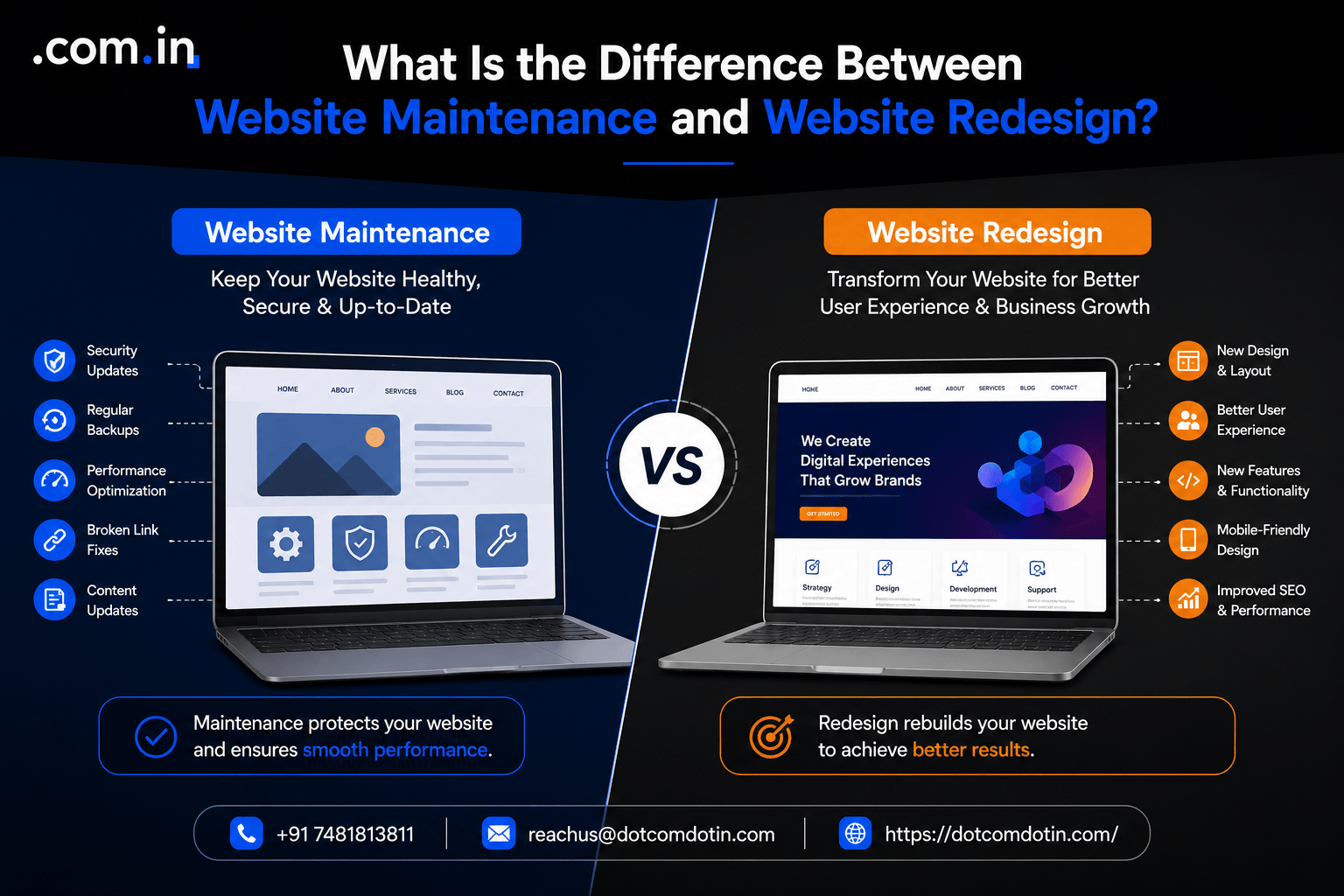
In simple terms, website maintenance keeps an existing website healthy, secure, functional, and up to date, while website redesign changes the website’s structure, appearance, user experience, technology, or overall functionality to meet new business requirements.
Choosing between the two depends on the condition of your current website, its performance, technical limitations, user experience, branding, and long-term business objectives. A website that only needs security updates and minor improvements does not necessarily require a complete redesign. On the other hand, fixing an outdated website repeatedly may not be worthwhile when its underlying structure is holding the business back.
For businesses investing in Website Maintenance Services in India, understanding this difference can help make a more practical and cost-effective decision.
What Is Website Maintenance?
Website maintenance is the ongoing process of managing, updating, monitoring, securing, and improving an existing website without fundamentally rebuilding it.
Maintenance can include technical updates, content changes, security checks, backups, performance improvements, broken-link fixes, plugin updates, database optimization, and monitoring of important website functions.
The primary objective is to keep the current website reliable and useful.
What Does Website Maintenance Usually Include?
Depending on the website platform and business requirements, regular website maintenance may include:
- CMS and software updates
- Plugin and theme updates
- Security monitoring and vulnerability fixes
- Website backups
- Broken-link checking
- Form and functionality testing
- Content updates
- Image optimization
- Page-speed improvements
- Database maintenance
- Mobile responsiveness checks
- Analytics and tracking checks
- SSL and security certificate monitoring
- Technical SEO maintenance
- Error and downtime monitoring
Regular maintenance is especially important for websites built using content management systems because outdated software, plugins, and integrations can create security or functionality problems.
A structured maintenance process helps businesses identify smaller issues before they become expensive problems.
What Is a Website Redesign?
A website redesign involves making significant changes to an existing website’s design, structure, user experience, content organization, functionality, or technology.
Unlike maintenance, which generally preserves the existing foundation, redesign is intended to improve or replace parts of that foundation.
A redesign may involve:
- New website architecture
- New visual design
- Improved navigation
- Mobile-first interface
- New page templates
- Improved conversion paths
- Updated branding
- New CMS or technology stack
- Better content organization
- New functionality
- Improved website speed
- SEO-friendly URL restructuring
- Integration with third-party systems
A redesign is generally considered when the existing website no longer supports the business’s goals effectively.
Website Maintenance vs Website Redesign: What Is the Main Difference?
The simplest distinction is:
Website maintenance = improve and protect the existing website.
Website redesign = rethink and significantly change the website.
For example, replacing an outdated plugin, fixing a broken form, updating website content, or improving image loading is normally maintenance.
Changing the navigation structure, rebuilding page templates, implementing a new brand identity, migrating to a different CMS, or creating an entirely new user experience is more likely to be a redesign.
| Factor | Website Maintenance | Website Redesign |
|---|---|---|
| Main purpose | Keep the website healthy | Improve or rebuild the website |
| Scope | Ongoing and incremental | Large-scale and strategic |
| Design | Minor adjustments | Major visual changes |
| Content | Updates and corrections | Restructuring and rewriting |
| Security | Regular updates and monitoring | Security considered during rebuild |
| UX | Small improvements | Major UX transformation |
| Technology | Maintain existing technology | May introduce new technology |
| SEO | Preserve and improve | Requires migration and SEO planning |
| Frequency | Regular | Occasional |
| Cost | Usually lower | Usually higher |
| Business disruption | Generally limited | Greater during development and launch |
When Should You Choose Website Maintenance?
Website maintenance is usually the better option when the core website is still functioning properly.
You may only need maintenance if:
1. Your Website Design Is Still Relevant
If the website looks professional, works well on mobile devices, and represents your brand effectively, there may be no reason to rebuild it.
Regular content and technical improvements may be sufficient.
2. Your Website Is Generating Leads or Sales
A website that consistently generates inquiries, bookings, sales, or other valuable actions should not automatically be replaced.
First identify what is working and what is not. Targeted maintenance and optimization can sometimes deliver improvements without the disruption of a complete redesign.
3. Your Website Has Minor Technical Problems
Broken links, outdated plugins, slow images, incorrect forms, security updates, and small functionality issues are typically maintenance tasks.
4. Your CMS Is Still Suitable
If your current content management system supports your business requirements and your team can manage it efficiently, there may be little reason to migrate.
5. Your Business Goals Have Not Changed
If your products, services, audience, branding, and overall digital strategy remain relatively stable, maintenance may be sufficient.
When Should You Consider a Website Redesign?
A redesign becomes more appropriate when the existing website has deeper problems that routine maintenance cannot solve.
1. The Website Looks Significantly Outdated
Design trends are not the only consideration. An outdated interface can make a business appear less credible and can make important information difficult to find.
If the design no longer represents the quality or positioning of your company, a redesign may be justified.
2. The Website Provides a Poor User Experience
If visitors struggle to navigate your website, locate services, understand your offerings, or complete important actions, the problem may be structural rather than cosmetic.
A redesign can reorganize navigation, page hierarchy, calls to action, and customer journeys.
3. The Website Is Not Properly Mobile-Friendly
A website that performs poorly on smartphones can create usability problems and affect the overall page experience.
If responsive behavior cannot be effectively corrected within the existing structure, rebuilding the relevant templates—or the entire website—may be the better solution.
4. Your Business Has Rebranded
A major rebrand may require changes to colors, typography, messaging, imagery, navigation, page layouts, and content.
In such situations, a redesign can ensure the website reflects the new business identity consistently.
5. Your Technology Is Holding You Back
An old CMS, inflexible framework, poor codebase, incompatible integrations, or limited editing capabilities can make routine changes increasingly difficult.
When technical limitations affect business operations, redesign or redevelopment may be necessary.
6. Your Website Is Not Supporting Conversions
If visitors arrive but rarely submit forms, make purchases, request quotes, or contact your business, examine the complete customer journey.
The issue could involve messaging, page structure, navigation, calls to action, trust signals, forms, speed, or user experience. A redesign can address several of these factors together.
Can Website Maintenance Improve SEO?
Yes. Website maintenance can support SEO by keeping technical elements healthy and ensuring that important website functions continue to work correctly.
Maintenance may involve:
- Fixing broken links
- Updating outdated content
- Improving page performance
- Maintaining metadata
- Checking redirects
- Fixing technical errors
- Improving internal linking
- Optimizing images
- Monitoring indexing issues
- Maintaining structured data where appropriate
However, maintenance should not be confused with a complete SEO strategy. Search visibility also depends on content quality, relevance, authority, technical accessibility, user experience, and other factors.
Google recommends creating helpful, reliable, people-first content and making sure search engines can crawl and understand the site’s content.
Can a Website Redesign Affect SEO?
Yes. A redesign can either improve or damage organic search performance depending on how it is planned and implemented.
Common SEO risks include:
- Changing important URLs
- Removing valuable pages
- Losing optimized content
- Breaking internal links
- Incorrect redirects
- Changing website architecture without planning
- Blocking search engine crawlers
- Launching pages with technical errors
- Losing metadata or structured data
- Failing to monitor performance after launch
Therefore, SEO should be part of the redesign process from the beginning rather than added after the new website goes live.
A proper redesign should include URL mapping, content evaluation, redirect planning, technical SEO checks, analytics verification, sitemap review, and post-launch monitoring.
Which Is More Cost-Effective: Maintenance or Redesign?
In most cases, routine website maintenance costs less than a complete redesign because maintenance works with the existing website rather than rebuilding major components.
However, choosing maintenance simply because it is cheaper can become counterproductive if the website has fundamental problems.
For example, spending months fixing an outdated platform, repeatedly addressing compatibility problems, and making temporary design adjustments may ultimately cost more than a properly planned redesign.
The right question is not simply:
“Which option costs less?”
Instead, ask:
“Which option provides the best long-term value for the condition and goals of the website?”
Is Website Maintenance Still Necessary After a Redesign?
Absolutely.
A redesigned website still requires ongoing maintenance after launch.
A new website can develop technical issues, require software updates, receive new content, need security monitoring, and require performance optimization.
Think of redesign as rebuilding or upgrading the property, while maintenance is the regular care required to keep it working properly.
For businesses seeking Website Maintenance Services in India, the goal should be to establish a long-term maintenance process rather than waiting until something breaks.
How Do You Decide Between Website Maintenance and Redesign?
Use this simple decision framework:
Choose Maintenance If:
- Your website design is reasonably modern.
- The website is mobile-friendly.
- Your CMS is reliable.
- Your navigation works well.
- The website generates satisfactory leads or sales.
- Problems are mostly technical or content-related.
- Your business goals have not changed significantly.
Consider Redesign If:
- The design is substantially outdated.
- Navigation is confusing.
- Mobile usability is poor.
- The website is difficult to manage.
- Your technology is obsolete.
- Your business has undergone a major rebrand.
- Your website cannot support new functionality.
- Conversion performance is consistently weak.
- The existing architecture creates ongoing SEO or performance problems.
If you are uncertain, a website audit can help determine whether the problems are isolated maintenance issues or symptoms of a larger structural problem.
How DotcomDotin Can Help With Website Maintenance and Improvement
Businesses often need an objective assessment before deciding whether to maintain or redesign their website.
https://dotcomdotin.com/ can help businesses evaluate website performance, technical requirements, user experience, SEO considerations, and ongoing improvement opportunities.
The right approach depends on the website’s current condition and the organization’s goals. In some cases, ongoing website maintenance services may be enough. In others, a strategic redesign can create a stronger foundation for future growth.
The important thing is to evaluate the website before committing to a major investment.
Website Maintenance and Redesign Should Work Together
Website maintenance and redesign are not competing services. They serve different purposes and often work best together.
Maintenance keeps a website secure, functional, updated, and competitive over time. Redesign addresses larger structural, visual, technological, or strategic problems.
A business may maintain its website for several years and then undertake a redesign when its requirements change. After the redesign, ongoing maintenance becomes essential again.
Google’s guidance for AI search experiences also emphasizes unique, valuable content, strong page experience, technical accessibility, and ensuring that structured data accurately represents visible page content.
This means businesses should think beyond simply making a website “look modern.” The website should be technically accessible, useful to visitors, easy to navigate, and supported by accurate and valuable information.
Conclusion
The difference between website maintenance and website redesign comes down to scope and purpose.
Website maintenance is about protecting and improving what already works. Website redesign is about changing the website when its current foundation no longer meets business or customer needs.
For many businesses, the best long-term strategy is not to choose one permanently. Instead, maintain the website consistently, monitor its performance, and redesign when there is a genuine strategic or technical reason to do so.
If you are evaluating Website Maintenance Services in India, begin with an assessment of your current website rather than assuming that a complete redesign is necessary. A data-driven decision can help you protect SEO value, control costs, improve user experience, and create a stronger digital presence.
Frequently Asked Questions
What is the difference between website maintenance and website redesign?
Website maintenance involves regularly updating, securing, monitoring, and improving an existing website. Website redesign involves significant changes to the website’s design, structure, user experience, functionality, or technology.
How often should a website be maintained?
Website maintenance should be ongoing rather than performed only once a year. Security checks, backups, software updates, performance monitoring, and functionality testing should follow a schedule appropriate for the website’s platform and business needs.
How often should a website be redesigned?
There is no universal redesign schedule. A website should be redesigned when its design, technology, user experience, functionality, branding, or structure no longer supports business requirements.
Does a website redesign improve SEO?
A redesign can create better technical performance, usability, content organization, and site architecture, which may support SEO. However, a poorly planned redesign can also cause ranking and traffic problems.
Can I maintain my website without redesigning it?
Yes. If your website has a solid structure, suitable technology, good usability, and an appropriate design, regular maintenance and targeted optimization may be all you need.
Is website redesign more expensive than maintenance?
Generally, yes. A redesign involves substantially more planning, design, development, testing, migration, and launch work. Maintenance is usually an ongoing service with a smaller scope.
Will redesigning my website remove my Google rankings?
It does not have to. Proper URL mapping, redirects, content preservation, technical SEO, internal linking, and post-launch monitoring can help reduce the risk of losing existing organic visibility.
What should I do before redesigning my website?
Before starting, review analytics, search performance, valuable pages, URLs, backlinks, content, conversions, technical issues, user behavior, and current business goals. This helps ensure that useful assets are not unnecessarily removed.
Do new websites need maintenance?
Yes. New websites still require security updates, backups, performance monitoring, content updates, technical checks, and ongoing improvements.
How do I know whether I need website maintenance or redesign?
Start with a website audit. If the problems are mainly updates, security, content, performance, or small functionality issues, maintenance may be appropriate. If the underlying structure, technology, UX, branding, or functionality is fundamentally inadequate, a redesign may be the better choice.